
What are the advantages of interdisciplinary provocation and how could you utilise this approach in your practice?
Dinner for one is a talk by Andy Altmann at a sustainability conference in Berlin, He tells the story of his work with friend and artist for a project at Blackpool that aims to celebrate the local history of comedy. He Altmann begins telling the story of Blackpool and the cultural references for this project. The concept for the works was developed by artist Gordon Young. Young wanted to celebrate British comedy on a monumental scale. The idea was great, visuals gained approval from clients but with proposals for manufacture coming in at 5 or 6 million, this 5-year project would soon ground to a halt if an alternative was not found. The project needed to be sustainable and endure the weather conditions of the north west of England. Determined, Young and Altmann assembled a team of craftsmen and built their own factory in Hull. This type of work was new to everyone involved but working with specialists in their field the final outcome is an impressive nod to British culture, comedy and is very location specific. Altmann notes that the process and waste material were more of visual interest than the final outcome, I too agree that the process and the waste material are of interest and should be used in other art projects. I fond that this work would have failed had it not been for the collaborations of these individuals and the drive to see a project through. The impressive installation sits at the base of the Blackpool tower and engages tourists and the local community to reflect on the local history and the significance of the area.


Collaboration and interdisciplinary practice are being encouraged in my local area with the Plymouth Design Forum (PDF). They hold regular talks, launch briefs and aim to celebrate the design community within Plymouth. Each brief is set on a given theme and promotes the collaboration of professionals from different disciplines within the creative industries. With a growing number of studios popping up at the Royal William Yard, Plymouth is becoming a hub for artists and creatives. During this weeks lecture Susanna and Louize discussed other platforms for collaboration, these are spaces where people can come and create such as the Hackspace, others seem to be more of a business approach in the Policy Lab. Each focuses on design and the collaborative approach to making working lives beter.


The first insight on this week’s podcast lecture with Susanna Edwards and Louize Harries makes comments on the teachings of the Bauhaus. Louize suggests that anyone studying at any creative establishment has been affected by the Bauhaus effect and this has been true of me. If I think back to my college course, university degree the idea of interdisciplinary practice was encouraged and to some degree essential in the approach to given briefs. We were never bound to one medium but encouraged to experiment and I believe that through this process, especially in module one I have taken this idea of interdisciplinary practice and ran with it. I never seem to really settle on digital design in the first instance, I will explore other avenues and see where it will take me. This could be illustration, print, photography and design. This weeks lecture focuses on a much broader approach to this idea and insights from Louize Harries explore collaborations with a specialist who can bring a new dynamic to a project. Harries identifies her practice as being textile-based and through her Masters Degree she has had the opportunity to explore work that crosses over into technology and science rather than Art or Textiles.

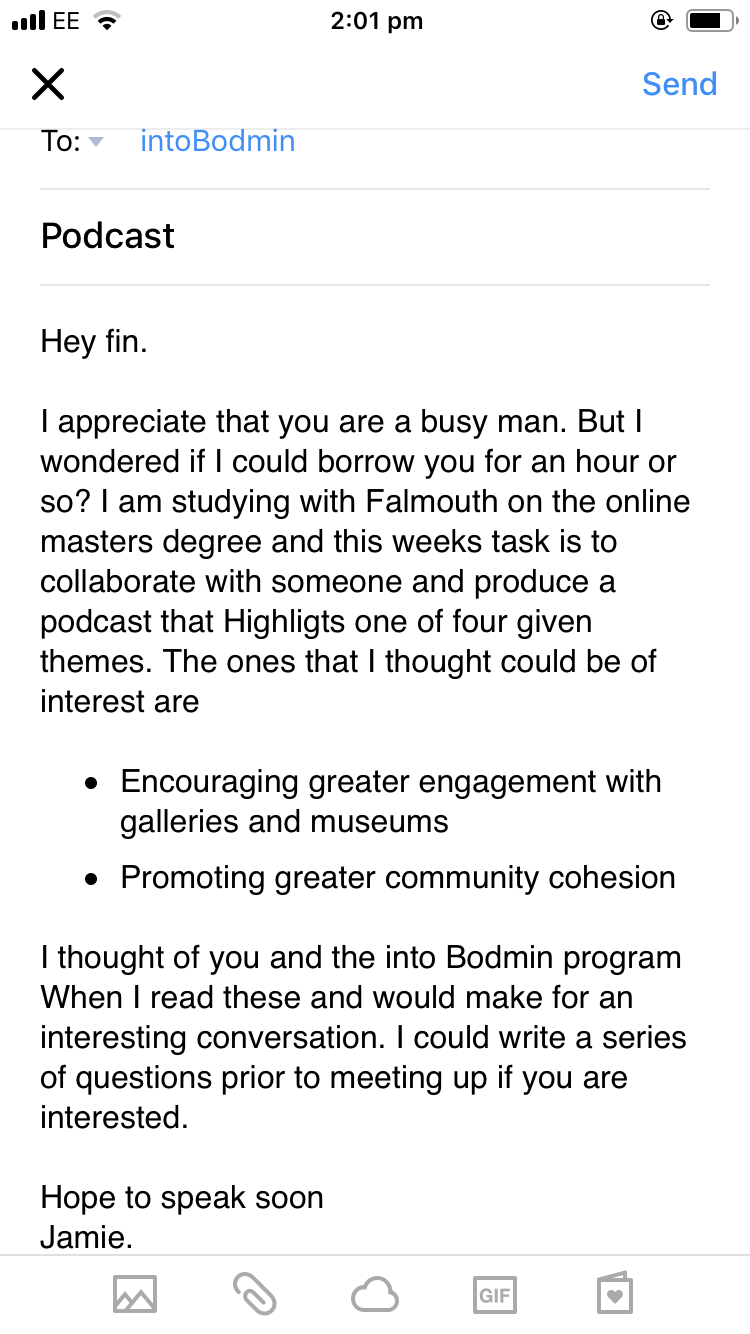
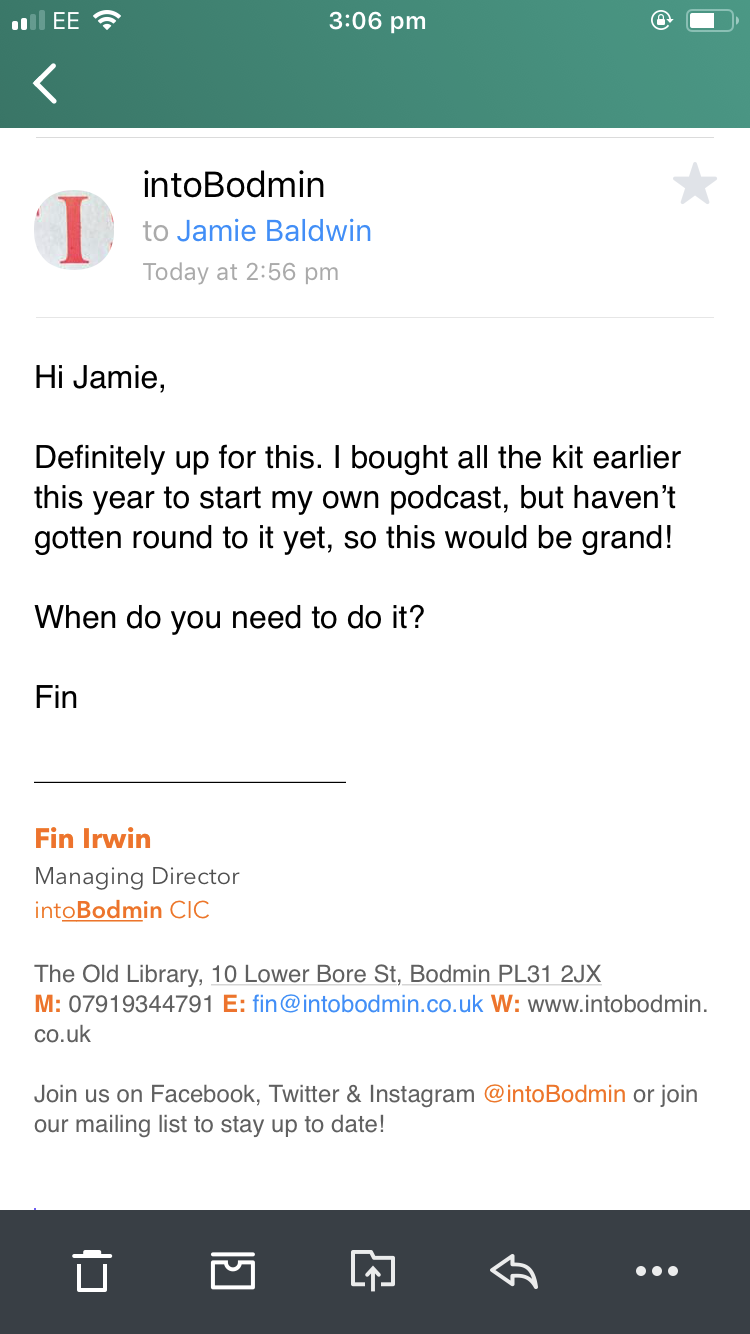
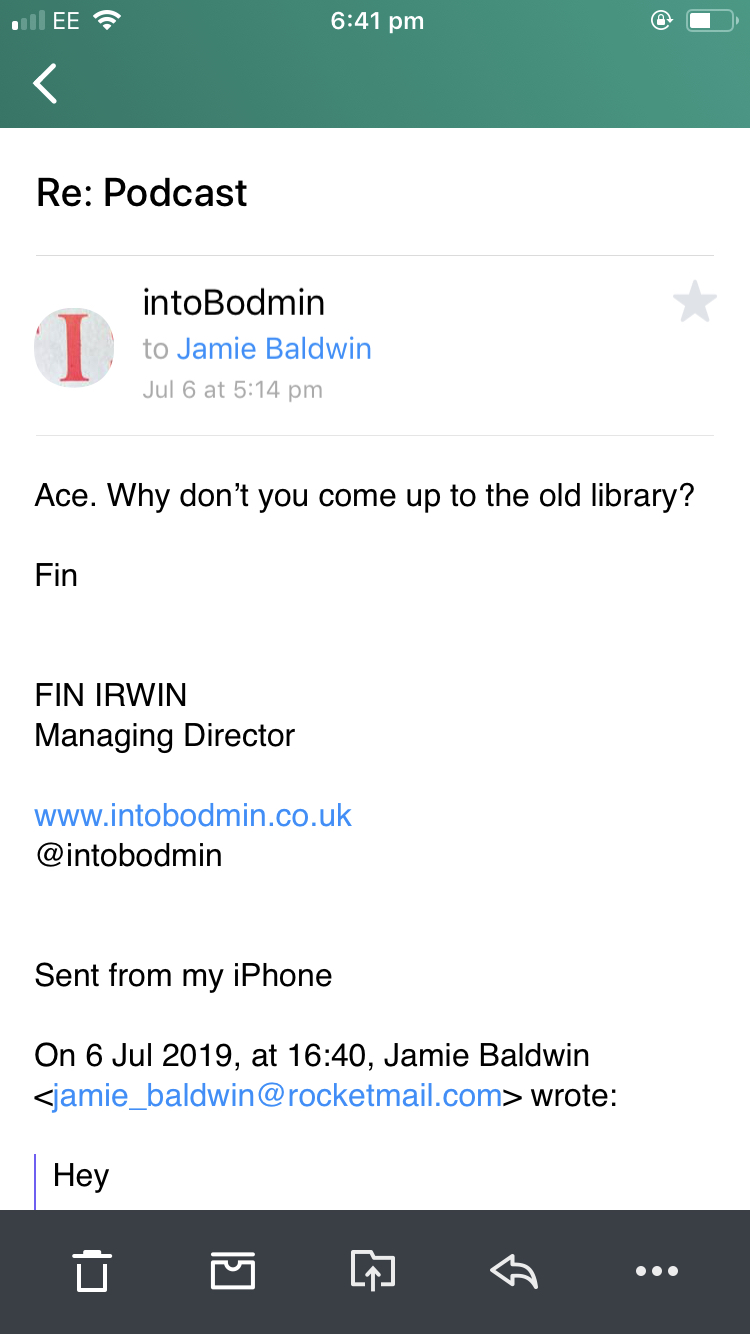
Having looked at this week’s themes I narrowed down two options that would not have necessarily been my first choice and I did this as I understood the time pressures of the task at hand. To collaborate with some and produce a podcast needed some quick decision making and maybe in hindsight, I need to have explored this idea further but I’m going to roll with it as I believe there is a conversation to be had about community engagement in Museums and Community Cohesion. I have worked with the partnership into Bodmin in the past and have just recently spoken to Fin, the Managing Director in an educational capacity I believed that we could work together on this. An email sent on Saturday, thinking that I would not be until Monday I would hear from Fin I started to explore the themes. Fin being the committed guy he is, replied quickly and a meeting was set up. I continued to explore the two themes and noticed a cross over in these and the work that into Bodmin do.
Considering the themes of Museum Engagement or Community Cohesion I started to explore both ideas as I believed that there would be a cross over in approaches. I started to think about my local area particularly and the barriers to each of these themes. As I have explored in previous projects there is a divide in Cornwall between true locals and outsiders moving in. This is more prominent in areas such as Newquay but still exists in areas like Bodmin. The tension between these two groups of people I believe is with the dislike of people from outside of Cornwall, mainly Londoners coming down and buying a second home. There is further begrudges towards outsiders with the shortage of jobs, stress on local services. This then makes me think that the Community Cohesion theme would be a tough one to crack but worth investigating. I have combined or looking broadly at these themes as there is a stigma that shadows Bodmin where it once stood as the centre and capital of Cornwall, a thriving town, it has slowly declined in its appeal. There is a high street with an array of shops and local amenities that is busy on a weekend with shoppers. The convenience of this is, of course, appealing to a section of the local community but I do wonder if this population, what percentage access some of the museums or points of interest in the town, how many people go out to eat on a regular basis in Bodmin. Speaking as only one person I know that while I do use the local greengrocer and supermarkets I do not, or have not been to any of the local interest points. Bodmin Jail, the Military Museum, events being held by into Bodmin. To develop an idea in approaching these themes I maybe should change my own perceptions and outlook on this. In some ways, my meeting with Fin will be good as I believe in what he is doing and believe it is good, meaningful work but I need to change my preconceptions about the town. While I do live in Bodmin for me it was more about location, accessibility and affordability of my home. It a decision that was less concerned with what is around Bodmin. I must confess that day out, dog walks tend to happen at the beach in Newquay, eating out is in Newquay or Padstow. I want to challenge myself and my ideas of Bodmin lets celebrate what is near and build a thriving town.
Barriers for Engagement:
- Interest in the local area
- Statistically a deprived area
- Perceptions of what people think it is like
- Access and parking
- Price to access events or points of interest
- Connectivity: Can the elderly access the town without support?
Reasons to visit:
- Cultural places of interest
- Recent renovations have improved the look and feel
- pockets of close communities
- Events are now becoming a regular occurrence
With this in mind, I started to think about questions I would pose to Fin and think about writing a script for the podcast. I believed that I could facilitate a project between the school and into Bodmin, this work already exists in some capacity, art projects are pitched to the school’s art department and students are encouraged to engage. The bigger question here would identify a group or groups of people who do not engage in the community and who do not engage in the events and points of interest. Reflecting on that statement, maybe I am the target audience. People from out of town not appreciating what they have on their doorstep and travel to other parts of Cornwall that maybe more tourist or have a certain feel.
Script: Intro to Podcast: Hello, my name is Jamie and I am a teacher and designer who is currently studying with Falmouth university for a masters degree in Graphic Design. This week I have been tasked to explore one of five given themes and have identified two that I would like to speak with Fin Irwin about today. Fin is the Managing director of an cultural engagement organisation called into Bodmin. Fin, do you want to tell us a little more about yourself, your background and how you come to develop this partnership?
- How did the project begin, what was the need that you had identified?
- Who do you feel is your target audience?
- Do you feel there are barriers to the work you do?
- Do you think that your work is about changing peoples perceptions?
- If so, how do you approach this?
What is interesting here is that I can see all the good work you are doing, you are investing time and money into the community and encouraging people to engage and try to take away the stigmas of Bodmin. I personally have not attended any events and feel that I should, there must be many others who feel the same. We come into town for our shopping but it isn’t a place that I personally associate with my social environment. What would you say to convince me otherwise?
It appears to me that the Cornish, and I say this in the appreciation that they see themselves as separate to rest of the UK. When I moved down here to Cornwall, on a job application I had to identify myself under the usual tick boxes of White, British, Irish, Asian, European etc but this application form had Cornish as an option too. Do you feel that the work you do is about joining the community together, people like me who have moved into the area and those who have been here for generations?
- Have you had any negative feedback from the local community?
- Do you feel you are creating a better community cohesion?
- With the community at the heart of this project, how do you communicate with them? is this the most effective way?
I think that it is impressive what you have achieved so far in the time you have been working on this, what do you consider to be your biggest achievement to date?
- What does the future hold for into Bodmin, how to propose to engage with more of the community?
- Do you work with other organisations such as Bodmin Jail and the Military Museum to engage with the community?

The conversation and recording of the podcast for this weeks workshop challenge was great, I had really enjoyed the conversation and it certanly opened my eyes to the great things that are happening within the local area. Fin is collaborating with organisations in the area to comtinue their message of community choesion. We spoke about the barriers to the projects and how he aimes to keep continuity of the message while working with a wide variety of people. I had written some what of a script but the conversation just seemed to flow and only on a few occasions did I have to use it as a prompt. I guess that this is a good thing and the fluidity of the conversation was just that and not an inverview rigid to the questions.
While Fin and the into Bodmin project is using the arts and cultural events to bring ideas and people together I believe that design can have its part to play in the communication of his message. This could be to brand the whole project in a way that ensures his message is not diluted through the mixed mediums and projects that are being held. Fin and I spke about the people of Bodmin and the interesting stories that are not being told. To bring my specalism into this I would propose a series of short publications that could be sold for profit for the organisation that tell the stories of local people. Fin and I spoke about a podcast that could also do a similar thing. A series of photographic artworks and stories could be developed that are ehibited around town that also celebrate the rich history of the area and the people in it.


 Pixels and Serifs.