


This weeks lecture has been an insight into the different business models that enable creative studios, collectives or freelancers to operate. It was interesting to hear the different approaches to business and how they affect the cash flow within the creative industry. With each model comes a different approach to roles and clients within the business. Studio director, Kate Moross identified a natural, progressive expansion within her business model but suggests that they are not interested in growing the company rapidly to take on more work. She acknowledges that the business needs to grow financially each year but does not take on more and more clients, similarly does not believe on expanding her employee numbers to accommodate extra work. This approach differs from that of the Lovers collective, they actively work with more people to grow the skill set within this alternative business model. This idea grew out of an observation from the founding members. Designers would leave a studio for a role where they would engage in work that was truly exciting. An interview for Computer Arts magazine with the Designers Republic also identified this as a problem within the industry. Designers would become bored of their ‘bread and butter work’ and would seek out more engaging clients or business opportunities. The Designers Republic sparked a series of designers to take on their own businesses/studios but claimed that it was easy to fall into a trap of the ‘agency’ business model. Designers would move into roles such as creative directors or project managers, moving away from designing for clients and overseeing the operation of the business. The Designers Republic aimed to take away this idea by enabling all involved to continue to design but to also take responsibilities for the day to day running of the business.


Ideas during this weeks lecture identified the approach to client work and how a creative business should price their services. This opened my eyes to the processes and considerations when pricing work. Watching ‘The Process’ from Chris Do, he identifies ways that designers should generate their pricing and how to increase revenue year on year. It is important to set clear goals but also set financial targets for the year. Christ breaks this target down and sets monthly and weekly targets that consider the overheads and outgoings of a business. From this, the business is able to reflect on the current climate of their clients and the amount of work coming in. Chris breaks down the time spent on answering briefs and to also managing the business. He advises that a significant amount of time should be allocated to new business leads and generating this. He is a big advocate of websites such as Behance and selling yourself on social media. This idea askes of the importance of a website and how this can impact on the business for new clients. Chris Do suggests that a client such as Addidas or a large corporate client would google search for a designer in their area, SEO optimization, while important he suggests that this would lead to smaller clients in a local area. Having work shared and appreciated by like-minded people is one way to build a community and connections to build an effective business that seeks to add to its client list.
This weeks lecture and my further reading/watching have given me an insight into ideas of running a business or a studio. For the workshop challenge, I would like to consider the opportunity to develop a magazine/publication. This follows on from the ‘about’ section written last week that I will continue to develop. I have found an area in design that I am interested in but would require collaborations with others and this is something that I would like to explore further. I have yet to decide completely on a specific avenue. A book publisher or a Magazine? This is based on the work I have explored in module 2 and have enjoyed the process of research, writing, and designing. For the workshop challenge this week I will consider the Magazine / Zine that focuses on Design in all areas.


From the starting point this week I have explored roles, costing and using a freelance business model to start. What would it cost to produce a magazine ‘INPRINT’? Below is a map that identifies some of the costing and roles that would be needed to establish this idea, all costs are based on estimates and would need to be refined. I believe that additional roles could be added, such as the sales and promotion of the magazine. Further research into the sales would be beneficial as I am estimating sales of 24000 per year. I also would need to identify the true cost to sell advertising space and gain interest from suitable clients. Avenues for the distribution would also need to be a consideration for further development and a refinement of the overall concept such as identifying a specific target audience.
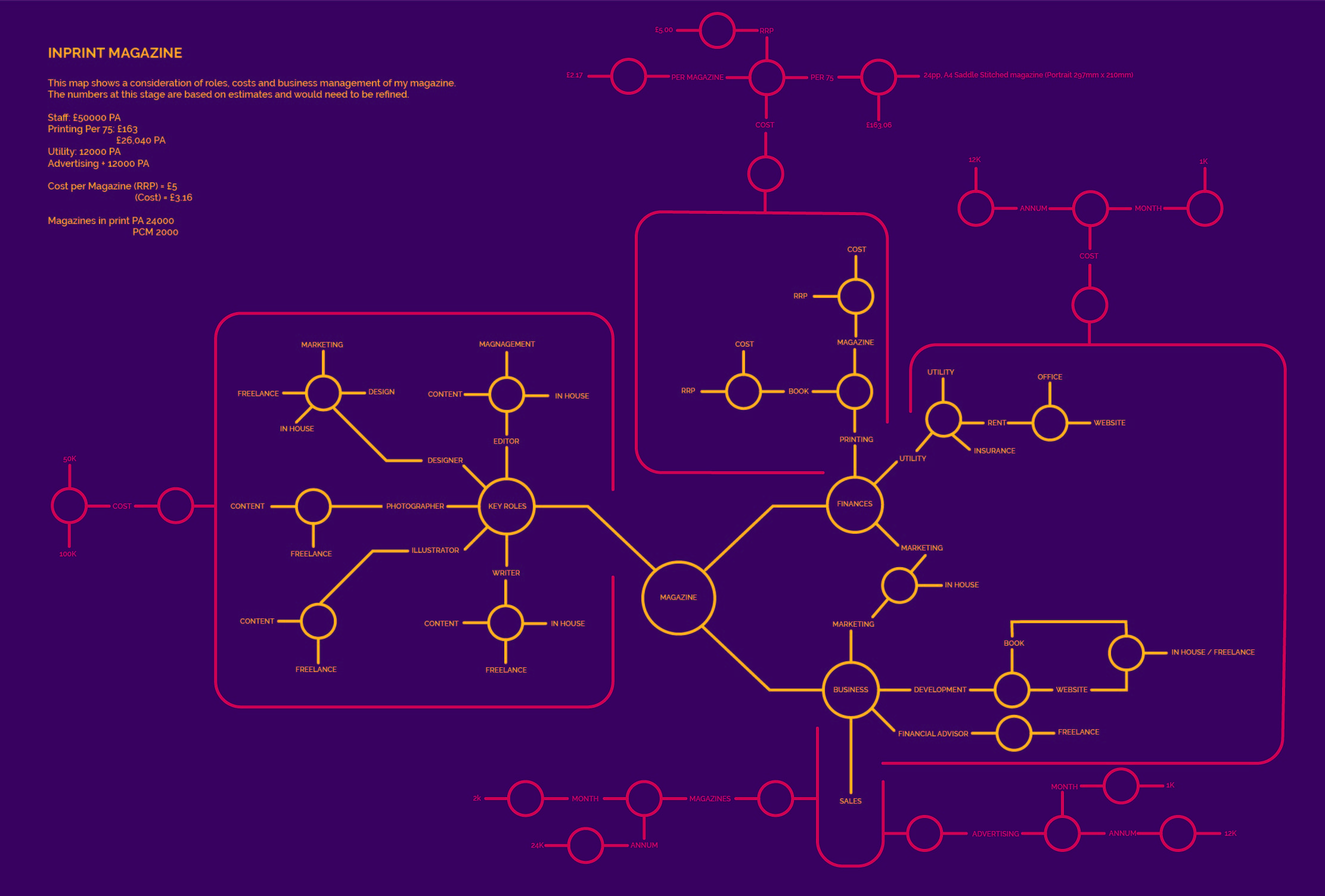
At this stage I had decided to use freelance writers, photographers and illustrators as these roles could be commissioned for specific works to suit each magazine issue. As this is the early stage I would adopt a multifaceted role, aiming to be the designer, writer and editor and bringing in people as and when. This idea would continue as the business grows but more permanent roles such as writers or designers could be introduced. The benefits of this is the flexibility of freelance work, this enables me to collaborate with a range of professionals with various skills that enable me to develop a product that is engaging and different each issue. Freelance or part time roles such as a financial advisor would enable the business to make sound financial decisions and balance the books. It is integral to the sustainability of the business that the finances make sense and ensure a profit for development and growth. Reinvestment into the business is essential to see its development and growth in sales. Using the link suggested on the ideas wall to read the payscales of the ‘mayjor players’ I found this interesting as a guide to prices for freelance creatives. At this stage my allocation of 50 – 100K a year would need to broken down into a budget for each issue and then into the work that could be out sourced.


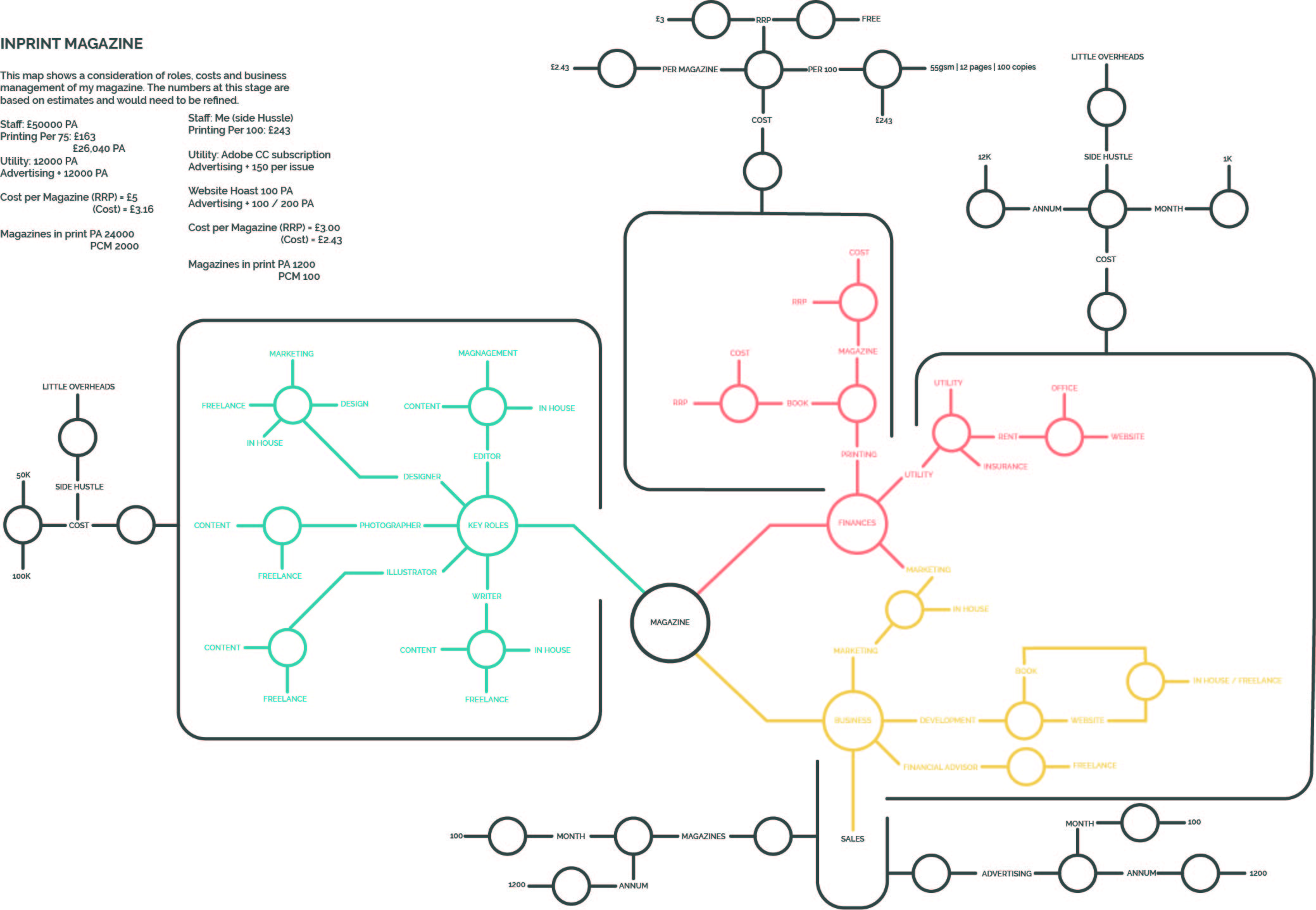
After a quick email to Alec he soon made me think of realistic goals to start with, the issue I had initially was that I had set out a salary for myself plus the cost of hiring freelance designers and writers. This then dictated how much revenue I needed to generate to make the payday. Initially this is unrealistic and maybe setting myself up to fail at this sage, so lets us back track and think small to begin with. I need to develop the idea further and also it will be more than the magazine, it would need to have a website and social media, of course. Generating an audience will be the biggest challenge. I have amended the graphic to represent a more of solo / side hustle (hate this term) adventure that could be worked on alongside my day job thus elevating the pressure for financial gains each month. While I have also suggested in the graphic that there would be a print each month, It could be that printed copies are every two month, this again would allow me to generate content, build the audience and secure funding for each issue. It could be possible to peruse crowd funding to generate a pot of cash that could be used for the printing, an investment of £10 could be rewarded with 4 copies of the magazine. This too could give me an insight into the viability of the project, is there a gap in the market for such a product? While Advertising could still be a avenue for revenue, I would not wish to bombard the platform with advertising as this could be a deterrent for some readers. My biggest problem at this stage is how to keep the magazine and website cheap or if at all possible free.

 Pixels and Serifs.